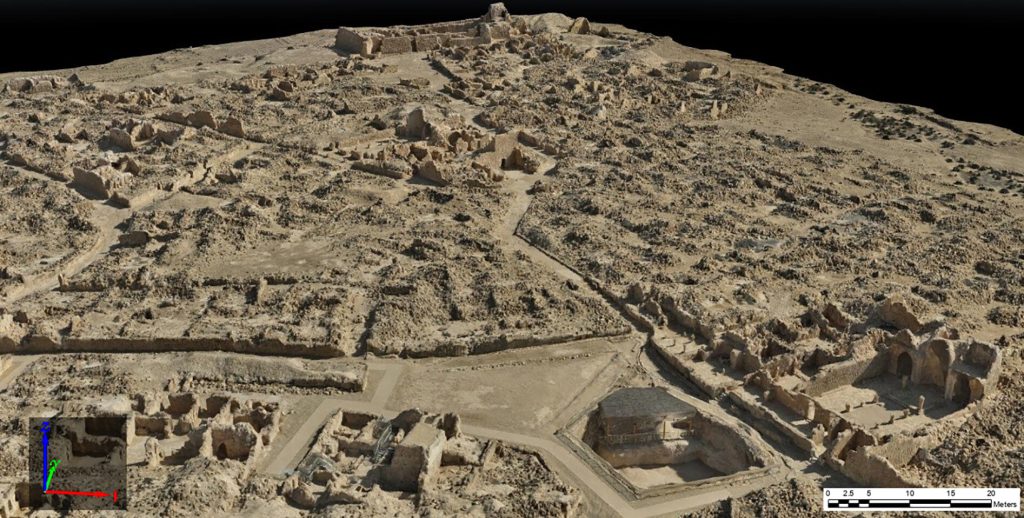

A new publication titled “Quantifying ancient architecture: Stone-level machine learning reveals architectural variation and settlement growth at Shivta” and authored by E. Uziel, G. Avni, G. Bar-Oz, and Y.Y. Jaffe, was just published in PNAS.
Archaeologists have long used buildings to investigate how ancient communities built, organized, and transformed their settlements. Yet architectural variability is often assessed through broad categories or labor-intensive measurements, making detailed, settlement-wide quantification impractical. Here, we use machine learning to measure individual building stones at settlement scale. Applied to hundreds of thousands of stones at Shivta, a Late Antique town in the Negev Desert, the method reveals differences in masonry characteristics, identifies a previously unknown settlement boundary, and provides evidence for outward expansion from a southern core. By linking stones to walls, households, neighborhoods, and settlements, this approach provides high-resolution evidence for comparing construction practices across ancient communities and potentially a basis for exploring socioeconomic differentiation.
Read the full text here.